Water stress: why integrated management matters

The last two years have been difficult for residents of India’s eastern city of Chennai in Tamil Nadu State. Monsoon rains have failed for two years and the city has braved a heat wave compounded by water scarcity.

On 19 June 2019, the state government announced that Day Zero—or the day when the city reservoirs were empty—had been reached. Local officials then announced that they would transport 10 million litres of water daily by train from 200 kilometres away to provide enough water, especially for the poor, to survive.

Chennai’s water stress is not unique to the city. From Cape Town, South Africa to Iran’s port city of Khorramshahr, individuals and communities in numerous countries worldwide have in recent years been suffering from water shortages.

Recent data unveiled by the Water Resources Institute in August 2019 shows that Qatar, Israel and Lebanon are experiencing an “extremely high” level of water stress with irrigated agriculture, industries and municipalities consuming, on average, more than 80 per cent of their available supply annually. India was placed thirteenth among the world’s 17 most “extremely water-stressed” countries.
Read More


Water Harvesting: Pipe Filters where there is a space crunch | Manohar Khushalani


Rainwater is amongst the purest water one can get distilled as it is by the sun. However, in a rainwater harvesting system, the water comes in contact with several surfaces, such as the roof or gutters. Its flow becomes possibly mixed with leaves or dust.

To get water fit for use at the end of the harvesting process, apart from keeping these surfaces clean, we can filter the water before storage. Ideally a water harvesting filter with inbuilt Sand and Aggregate filter is long lasting and requires less maintenance. See the link below for the design of such a pit.

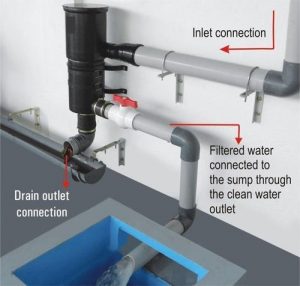
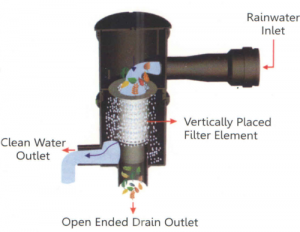
However when there is a space crunch you can use a modular pipe filter to be directly connected to the piping system from the roof to the borewell or dugwell to be recharged. For maintenance of that system you must refer to the manufacturer’s brochure.

Link to the Water Harvesting Filter Pit details:

Domestic Water Harvesting Ideas by Prof. Manohar Khushalani


Water Harvesting: Recharge Pit with built in Desilting Weir | Manohar Khushalani

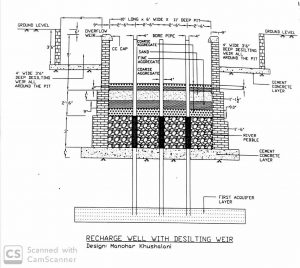
Recharge Pit with Desilting Weir- Design Manohar Khushalani

This Recharge pit can be used where the volume of water is large and there is not enough space to accommodate a desilting tank. The other advantage is that the surface water runoff can come from all four sides of the pit as the desilting weir can be all around the pit.

Important: The number of borewells depends on the volume of water. Minimum one , maximum two, Three borewells can be used only in exceptional circumstances. Under no circumstance, the borewell should be deeper than the firsr acquifer. This is to ensure that people dont use it for pumping out water from deep acquifers.


Water Harvesting: High Capacity Recharge Pit | Manohar Khushalani

Recharge Pit

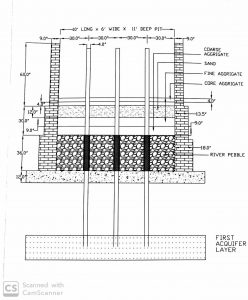
High Capacity Recharge Pit Designed By Manohar Khushalani

This Ground Water Recharge Pit is for Societies with many flats or in institutional areas. Size is Indicative depending on the size of the catchment. More than one Pit can be used if necessary. Water to such a pit should be cleaned through one or more Desilting Tanks. See the previous article on Desilting tank

Important: The number of borewells depends on the volume of water. Minimum one, maximum two, Three borewells can be used only in exceptional circumstances. Under no circumstance, the borewell should be deeper than the first aquifer. This is to ensure that people dont use it for pumping out water from deep aquifers.

If there is only direct surface runoff to the harvesting pit from surrounding areas see the next article on built-in desilting weir

Water Harvesting: Recharge Pit with built in Desilting Weir | Manohar Khushalani

For Pipe Filters (Not Recommended in large Catchments) See the link below

Water Harvesting: Pipe Filters where there is a space crunch | Manohar Khushalani


Water Harvesting: Desilting Tank for removal of suspended impurities | Manohar Khushalani

Desilting Tank

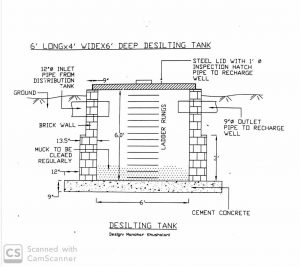
Desilting Tank Design by Manohar Khushalani

After the harvested water is brought down from the catchment area this tank is used to remove the silt from the water.  Dimensions are indicative. The size will vary depending on the amount of water coming in through the inlet pipe. more than one tank can be used in series if the first tank does not remove all the impurities. The Desilting tank should be cleaned in the dry season every year. Water outlet from the last desilting tank in the series will be sent to the Recharge Pit

For details of Recharge Pit with inbuilt filter :

Water Harvesting: High Capacity Recharge Pit | Manohar Khushalani


Watch: Greenland Ice Sheet Turns Into 10 Billion Tonnes Of Water In Hours

Greenland ice sheet ‘rapidly melting’ as Europe heatwave moves north

A heatwave that last week gripped Europe and sent the mercury soaring, causing record temperatures in several countries, has now settled in Greenland and the results are startling.

When one thinks of Greenland, images of an icebound, harsh and forbidding landscape probably come to mind, not a landscape of ice pocked with melt ponds and streams transformed into raging rivers. And almost certainly not one that features wildfires.

Yet the latter description is exactly what Greenland looks like today, according to imagery shared on social media, scientists on the ground and data from satellites.

An extraordinary melt event that began earlier this week continues on Thursday on the Greenland ice sheet, and there are signs that about 60% of the expansive ice cover has seen detectable surface melting, including at higher elevations that only rarely see temperatures climb above freezing.

Read more……

https://www.ndtv.com/world-news/watch-greenland-ice-sheet-turns-into-10-billion-tonnes-of-water-in-hours-2079180


With a whopping 206 mm of rains, Naliya surpasses July average rainfall | Skymet

Naliya is the extreme western part of the country. Kutch district is the least rainy pocket right from Naliya, Mandvi to Bhuj. The entire Kutch district is an arid region and is surrounded by the Gulf of Kutch. In the past 24 hours, Bhuj and Naliya recorded 38 mm and 102 mm of rains, respectively.

According to meteorologists at Skymet, Kutch will now witness light rains with moderate spells in between for next two to three days. With the arrival of the new system which is very likely to brew in the Bay of Bengal will act as a catalyst and would then give torrential rains over the region.

Read on …

https://www.skymetweather.com/content/weather-news-and-analysis/with-a-whopping-206-mm-of-rains-naliya-surpasses-july-average-rainfall/


Maple Tree Farm | Currylines – Caroline’s

In a quiet little village of Thally there is a revolution in the making. Mapletree Farm is literally ‘plot’ting and framing farming ideas and processes that are ethical, sustainable and to’Thally game changing in the long run (sorry but I had to begin with a pun).

Thally is near the town of Hosur in the Krishnagiri district of Tamil Nadu, India and the produce of the farm is marketed in the neighboring state of Karnataka.

When I first heard about Mapletree farm on social media, it automatically brought visions of Canada and I was puzzled as to what its produce was doing in the land of Kannada 😀

Well that is a mystery I have not really solved and though such things are terribly important to me 😀 I will not dwell on it now because I have a lot of other exciting and fascinating information about this organic farm which I want to share with you.

Mapletree farm has rapidly risen to considerable proportions in a short span of 3 years and plans not to stop until it conquers the entire country with its principles and converts as much of the land as possible, into ethically farmed regions, which as we all know, is definitely the need of the hour.

Read on….

https://currylines.com/maple-tree-farm/


How to construct a Water Harvesting Pit | Jalam Jeevam

Ground water is one of the important sources of water in urban areas. With increasing urbanization, underground water has been indiscriminately exploited, causing depletion in water table and water availability. It is very evident from the number of failing borewells/Open wells that it is unsustainable to pump out water from wells without recharging the same from the rain water. To reverse the trend or to reduce the effect of over exploitation, ground water recharge needs to be taken up on a large scale at residential and institutional buildings.

There are many methods of ground water recharge. Following are few methods for recharging groundwater using rain water from rooftop of buildings and other sources:

https://jalamjeevam.telangana.gov.in/rain-water-harvesting/how-to-construcrt/


How ancient India preserved the traditional heritage of water resources – The Hindu

Ahead of the World Environment Day, experts say that traditional knowledge methods seems to be the only way to counter the approaching national water emergency
Large number of water bodies built by women include step-wells, tanks and even ponds such as the world heritage site of Queens Step-well (Rani Ki Vav) in Patan, Gujarat, and the Rani and Padam Sagar in Jodhpur. There is the mention in a Kaifiyat (an early colonial document on land holdings) of a Devadasi building a tank in Yagati, and Nagamandala in Karnataka adds Navina Jafa in Hindu

Read on….

https://www.thehindu.com/entertainment/art/drops-of-wisdom/article27298044.ece