Modern Indian Poetry by women poets isn’t just about feminism. We all agree that women have suffered for centuries and now have a voice to revolt openly but as their educational capabilities have expanded beyond patriarchy they are also writing on travel, adventure, science, fine arts and politics. But I should not have conflict with men who laid the railway track through my native village. I have written on Benares, Poetry and Science Opposites meet, Combating War by Art and Poetry my dear friend Rachna Joshi has written on travel tapestry, Usha Mujoo Munshi has written on Situation in Kashmir, Mayura Tiwari has written on many themes, Neelam Saxena Chandra has written on Brussels, Tanuka Endow has written on Time, Sukrita Paul Kumar has penned on The Chinese Cemetery and above all J. Bhagyalakshmi has written on Let there be Peace All Around. Similarly several women poets have taken up several different subjects, issues and written wonderful poetry and not just on troubles the women face because of men.
Racha Joshi writes in Celestial Nights
At Edfu, on a ride through the old city we go to Horus temple see the falcon headed Sphinx and the shrine of God.
Here her fleeting mind goes to Egypt and her secular self watches Horus temple.
I too have no grudge with men, as there are several situations when I was encouraged by men. I write though on women of the Hills, women of desert, women near the river. But i have also written in Cosmic Tour,
I cosmic dust Miniscule life in a gigantic universe
Also on Prakriti and Purusha on feminine and masculine genders.
Swami Vivekananda who was a great advocate of women’s independence and education, mentioned ” A Bird of humanity can’t fly with one wing.”
Lets respect men and women both as humanity needs two wings to fly. Whenever protest is needed we will but will also acknowledge the bridge across the river which has been made by a male labour’s hands.
To quote J. Bhagya Lakshmi who says no to suffering and violence, no to battles and conflicts, and no to Hiroshima and Nagasaki and writes against Terrorism. I write art and poetry that can combat war, like through works of Picasso and Salvador Dali.
My objection is with crying women. Let you explore many dimensions of life and be fearless to combat negativity. All of us are not paragons of virtue, this implies for both men and women. Women be fearless and express your identity in verses eloquently. And you are doing it.
Mandira Ghosh Secretary and treasurer The poetry society India
My take on Equity Investment tax in India rejig / Shantanu Goel
India Union Budget, July18 2024
By Shantanu Goel
July 18, 2024
Current landscape: Indian stock markets are trading at an all-time high with Sensex shattering 80k mark and Nifty at arms length with 25k, translating to 25% returns over last 1 year These are unprecedented numbers which are largely driven by 5 factors – India’s strong economic growth numbers, continuity in governance, expanding retail participation, high interest rate in developed economies and China’s struggles over the post covid era
What would the government want to achieve: The government would love to continue the narrative that India is rightfully on the path of success. Stock market numbers are a great tool to demonstrate just that. Post general elections, the most potent tool to influence the markets is – the Union Budget Therefore, the government would be inclined to take steps to directly influence the market numbers (in addition to indirect actions like increased Capex and fiscal spending)
How can they achieve it: One way to influence the long term growth of an economy, and hence the stock market is – (in India’s case) increased government spending For perspective, India has historically been a consumption driven economy with close to 60% contribution to the GDP driven by domestic consumption The current regime has tried to push the Capex by unprecedented investment in infrastructure – thereby propelling the GDP from Government Spending component
However, infrastructure is slow to build and it won’t reflect in growth numbers quickly. So to influence the story, the government needs to bring in policies which will impact (maintain) short-term growth of the market Therefore, I believe the government could use taxation as a tool to achieve this
Options at hand: There are 3 options that the government can explore:
1. Adjustment to long-term capital gains tax: increasing it can bring shockwaves to the market, so thats not viable Decreasing it can help maintain stability to the current numbers but will create a loss to the exchequer which needs to be filled from somewhere else
2. Adjustment to short-term capital gains tax: Any change to this won’t lead to any material benefit, so the government is not likely to consider it
3. Adjustment to tax on F&O: Decreasing it doesn’t seem to offer much benefit so we’ll skip dwelling into it Increasing it will impact the trading in short-term, but will stabilise in medium term. Also, this will be in continuation to the government’s stance on warning retail investors to be “cautious” of F&O trading and be mindful of its dangers
My predictions:
Possibility 1: The government increases the F&O tax but will balance it by reducing (potentially removing) long term capital gains tax in the Union Budget of July 2024
Possibility 2: The government increases increase the F&O tax but will balance it by increasing the exemption limit of long term capital gains tax from 1 lakh to 3-5 lakhs in the Union Budget of July 2024
Either option may create waves in the short term but will help to stabilise the markets in the medium term as it will incentivise investors to hold their investments for a longer term – thereby also avoiding the “imminent” market crash
Best regards Shan
EMPATHY AND COMPASSION
Empathy and Compassion
By Sunil Sarpal
We are living in an age (time) where we have literally forgotten the virtues of the above words. The above words are rendered meaningless and lost their significance in our lives. Running on a fast lane, perhaps, man has zeroed down to so much practical approach that humanity has lost its meaning and become a thing of the past. Where will such a scenario lead to, God knows.
God has created this creation and put human beings on top of the ladder. A human being should not dis-associate himself from ‘human’ nature by behaving and acting like an animal.
Both ’empathy’ and ‘compassion’ are an integral part of human life.
Human nature should not deteriorate to the level so that God starts challenging it by introducing deadly viruses such as Corona.
If all ‘yonies’ behave and act like what is expected of them, there cannot be any kind of unusual chaos we may have to counter with.
First and foremost, we should be good human beings then an Engineer, Doctor, Scientist, or businessman.
Love life to the fullest, so do with our brothers and sisters and always maintain peace and harmony all-around by shedding hatred and animosity.
If you find a negative a minded person, maintain a discreet distance from him and do make him realise that you do not belong to his type of creed
Discard the company of negative-minded people and embrace and propel goodness all-around. After all, we are human beings endowed with a sense of discrimination.
Fulfilment of a divine dream by L. K. Advani
“When Prime Minister Shri Narendra Modi does the ‘Pran Pratishtha’ of Shri Ram Lalla’s idol at Ayodhya, he would be representing every citizen of our great Bharat”.
“Shri Ram embodies the spirit of India. The true spirit of India and Indianness is discipline, truth, honesty, ethics, moral values, acceptance and celebration of diversity, respect for elders, strong family bonds and all such fine human values“
SHRI RAM MANDIR – Fulfilment of a divine dream The Original Unedited Article by Shri Lal Krishan Advani
I am elated beyond words that we are on the verge of realising my most cherished dream of having a grand Shri Ram temple at Ramjanmabhoomi, the birthplace of Shri Ram.On 22nd January 2024, Prime Minister Shri Narendra Modi will install the idol of Shri Ram at the beautiful temple in Ayodhya, and I feel blessed that I will witness this historic occasion in my lifetime.
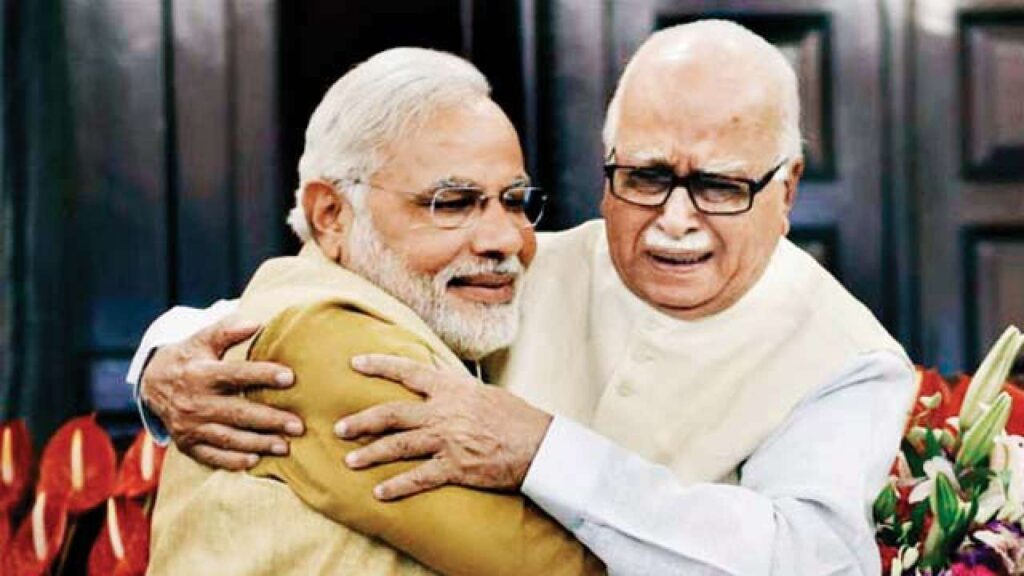
PM Modi greets Shri LK Advani on his Birthday every year
I have always believed that ‘faith’ is the foundation on which rest both a meaningful life of a person and the whole society at large. Faith not only infuses energy and confidence into a person’s life, but also helps give it direction. For me and for crores of Indians, this faith has been our deep reverence for Shri Ram.
Shri Ram embodies the spirit of India. The true spirit of India and Indianness is discipline, truth, honesty, ethics, moral values, acceptance and celebration of diversity, respect for elders, strong family bonds and all such fine human values and Shri Ram is the epitome of all these impeccable human qualities. Hence the title ‘Maryada Purushottam’ (an exemplar among good human beings) by which he is known. He is an ideal for Indians’ aspiration to live a life of higher values.
Shri Ram was also an ideal king- the living embodiment of ‘Dharma’. Hence the concept of ‘Ram Rajya’, the epitome of good governance, was extolled as the ideal for India. Although Shri Ram is the holy religious figure worthy of worship for the Hindus, he is a pre-eminent symbol of India’s cultural heritage and national identity -which belong to all citizens alike.
The story of Shri Ram’s life, the Ramayana, is both a source and a carrier of the continuity of India’s cultural traditions and has greatly influenced the Indian mindset generation after generation, century after century. Therefore, for the last almost 500 years, the reconstruction of the Ram Temple in Ayodhya has been a deep desire for countless Indians.
The Ramjanmabhoomi movement for the reconstruction of the temple at the Janmasthan of Shri Ram in Ayodhya proved to be a major watershed in the history of post-1947 India. Its impact on our society and polity, and on our sense of national identity has been tremendous.
In my own political journey, I have always said that the Ayodhya Movement was the most decisive transformational event, which gave me an opportunity to discover India anew, and in the process, rediscover myself.
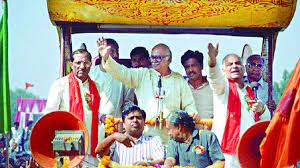
I feel humbled that destiny made me perform a pivotal duty in the form of the Shri Ram Rath Yatra from Somnath to Ayodhya in 1990.
I believe that before any event finally occurs in reality, it takes shape and form in a person’s mind. At that time, I was feeling that a befitting temple for Shri Ram in Ayodhya would indeed be a certainty one day, and that it was only a matter of time. A grand Mandir for Shri Ram at Ramjanmabhoomi had been a desire and mission for the Bharatiya Janata Party. When in the mid-1980s the Ayodhya issue rose to the centre-stage of national politics, I was reminded of the time how political stalwarts like Mahatma Gandhi, Sardar Patel, Rajendra Prasad and K M Munshi had, against all odds, effectively steered the reconstruction of another landmark temple in independent India- the Somnath Temple at Prabhas Patan on the coast of Saurashtra in Gujarat.
Somnath was both a witness to, and a target of, multiple foreign invasions during the medieval period. And reconstructing the Somnath temple was a proud testimony of India’s determination to erase the history of bigoted alien attacks and regain its lost cultural treasure.
Sadly, as in the case of Somnath, the temple at the birthplace of Shri Ram in Ayodhya had also become a target of attack by an invader, Babar, who founded the Mughal empire. In 1528, Babar ordered his commander Mir Baqi to erect a mosque at Ayodhya to make the spot a ‘place for descent of angels’- hence the name Babri Masjid. It is widely believed, and later even confirmed by compelling archeological evidences that there was a pre-existing temple at Ayodhya which was demolished for establishing the mosque.
So in many ways, the Ayodhya movement was the continuation of the spirit of Somnath. When the BJP decided in 1990 that I, as its President, should lead the Shri Ram Rath Yatra to mobilise people’s support for the Ayodhya movement, it took no time for me to choose Somnath as the starting venue of this historic journey.
On 12th September, 1990, I called a press conference at the party office at 11 Ashoka Road, New Delhi and announced my decision to undertake a 10,000-kilometre-long Rath Yatra, starting from Somnath on 25th September and reaching Ayodhya on 30th October to join the kar seva in Ayodhya, planned by the saints associated with the movement. 25th September was special to me as it is Deendayal Upadhyaya ji’s birth anniversary. In my autobiography- “My Country My Life”, I have extensively talked about the Ayodhya Movement and the Shri Ram Rath Yatra that I undertook in 1990. On this momentous occasion today, I would like to recall some significant portions from it. On the morning of 25th September 1990, I offered prayers at the jyotirlingam in Somnath temple. I was accompanied by the present Prime Minister, Shri Narendra Modi (who was then a promising leader of the BJP), Shri Pramod Mahajan, (who was the General Secretary of the party) other senior functionaries of the party in Gujarat, and members of my family. Rajmata Vijayaraje Scindia and Shri Sikander Bakht, both Party Vice-Presidents then, had come to flag off the Rath.
Before the Rath was flagged off, we all paid floral tribute to the imposing statue of Sardar Patel just outside the temple. In my mind, I thanked and drew inspiration from all the great men who had toiled for the reconstruction of the temple. Amidst a large crowd that had gathered to greet and bless us, we climbed the Shri Ram Rath which had been decorated with marigold flowers. Then, to the accompaniment of the sound of the ceremonial conches and full-throated slogans of ‘Jai Shri Ram’ and ‘Saugandh Ram ki khate hain mandir wahin banayenge’ (In the name of Ram, we resolve: We shall build the temple there—at Ramjanmabhoomi—itself), the Rath rolled on. In subsequent days, these slogans became identified with my yatra and a song-“Ram Naam Mein Jaadoo Aisa, Ram Naam Man Bhaaye, Man Ki Ayodhya Tab Tak Sooni, Jab Tak Ram Na Aayein…” sung by late Smt. Lata Mangeshkar, India’s Nightingale, became the signature tune of the Rath Yatra wherever it went.
I was truly overwhelmed by the response to the yatra within the first few days of our journey in Gujarat. The Rath was received by tumultuous crowds everywhere—in villages, towns and even along roads where people from nearby hamlets would gather under trees eagerly waiting for the Rath to arrive. The response reached a crescendo in bigger towns and cities, where it would take hours for us to reach the venue of our meetings.
This response was as big, even bigger, in Maharashtra as well as in all the subsequent states that we travelled through. People everywhere greeted the Rath by erecting ceremonial arches and showering flowers. The most astonishing sight for me was the manner in which people, especially women, would come forward and perform aarti and throw coins, as if they were praying in a temple. What I soon realized, was, that for many people, I was secondary and incidental to the campaign. I was only a sarathi or a charioteer; the principal messenger of the Rath Yatra was the Rath itself. And it was worthy of worship as it was headed for Ayodhya for the sacred mission of construction of the Shri Ram Temple at his birthplace.
At this point, I would like to talk a bit about the ‘Rath’ that I travelled in. It was a actually a mini truck that was redesigned to take the shape of a Rath and was provided with basic amenities.
Travelling in a ‘Rath’ was indeed a novel experience for me, but it presented its own set of challenges. For one, it had a small room-cum–washroom at the rear of the vehicle, which could only be used when the vehicle was not in motion, otherwise it was very bumpy. So I recall standing most times on the platform of the moving vehicle, holding on to the front and side grip bars in order to maintain my balance. Of course, this also meant being constantly subject to heat and dust as the platform was open from three sides.
Also while in motion, it was impossible for me to sip water, juice or tea without spilling. So a special sipper bottle was arranged to overcome this issue. As for food, although arrangements were made that the dinner would come from some party worker’s home in whichever city we were to reach for night halt, invariably the last public meeting would only end up close to midnight. So I would usually have just a glass of milk with marmalade on toast.
Another problem we often faced was due to the height of the Rath. Although the party officials had circulated the information about the height of the vehicle to various destinations along the route of the yatra, as we moved through small towns and cities, one of the frequent hold ups used to be the overhead hanging electrical wires. So party workers then arranged for extra long wooden poles to get the wires out of the way and also started moving along with the Rath. Well, all these were really miniscule issues which form just a small part of the beautiful memory of my Shri Ram Rath Ratra. The most touching moments of the yatra were witnessed in villages and remote hamlets where the piety on the faces of the village folk was of a purer and deeper kind than what I saw in cities. Many of them were either illiterate or nominally educated. They had not learnt about Shri Ram by reading; it was as if the knowledge flowed through them, passed on from one generation to the other, through folk tales or word of mouth, as usually happens in the Indian society.
At many places, I found an odd villager who would come quietly, without shouting any slogans, perform a puja before the Rath, greet me and walk away. I was truly humbled by experiences like these as it gave me a first-hand insight into how deep-rooted religiosity is in the lives of the Indian people. It was the Rath Yatra that made me realise that if I were to communicate the message of nationalism through the religious idiom, I would be able to transmit it more effectively and to a wider audience.
My speeches, delivered mostly from the specially designed raised platform on the vehicle were just about five minutes long, because I had to address nearly twenty to twenty-five such roadside receptions each day. In most towns and cities, I had to get down and address public meetings attended by tens of thousands of people.
I would explain the purpose of the yatra and the circumstances that compelled the BJP to actively participate in the Ramjanmabhoomi movement. Although the people’s response to the Rath Yatra was mainly religious, the focus of my speeches was on nationalism, as I have always believed that the Shri Ram temple issue is intrinsically connected to our sense of Indianness. A recurrent theme in my speeches was that the power of a positive approach to religious faith can contribute greatly to social transformation and nation-building. I stressed on the equal status that our Muslim brethren enjoyed in independent India as India chose to remain non-theocratic and secular. This, I added, was principally due to the age-old secular ethos of Hinduism. I also appealed to leaders of the Muslim community to respect the Hindu sentiments over Ayodhya. My yatra was scheduled to enter Deoria in Uttar Pradesh on 24th October 1990. However, as I had anticipated, it was stopped at Samastipur in Bihar on 23rd October and I was arrested by the Janata Dal government in the state, then headed by Shri Laloo Prasad Yadav. I was taken to an inspection bungalow of the irrigation department at a place called Massanjore near Dumka, on the Bihar-Bengal border. This action invited angry and spontaneous protests all over the country.
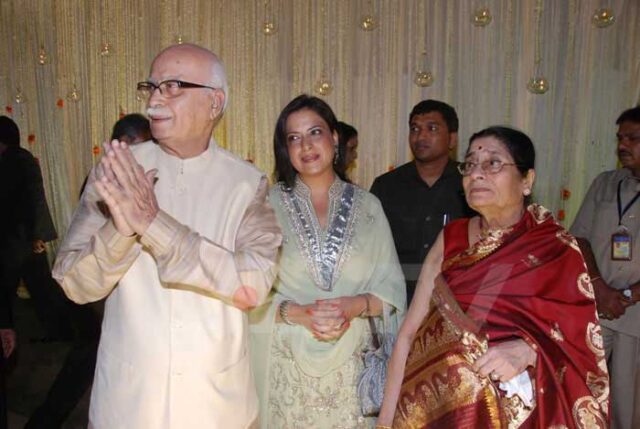
LK Advani with Daughter Pratibha and Wife Kamla
This was a time when there were no mobile phones. The news of my arrest reached my daughter Pratibha, who was in Kolkatta then, in quite an interesting manner. She was looking to hire a cab on way back to her home when the taxi driver told her to hurry up. On her enquiring from him why he was saying so, the taxi driver told her that Advani “Baba” had been arrested and people were fearing a backlash in the form of riots in the city! Two days later, Pratibha spoke to Laloo Prasad Yadav ji, who facilitated her coming to meet me at Massanjore during my detention. I spent five weeks in detention before being released.
Thus ended my Shri Ram Rath Yatra, which was indeed an exhilarating episode in my political life. I felt happy that the Yatra helped in galvanising the aspirations, energies and passions of its countless participants.
A significant debate that started during the course of the Ram Janmabhoomi movement was the difference between genuine secularism and pseudo-secularism. On the one hand, there was a groundswell of popular support for the movement. On the other hand, most political parties were shying away from supporting the movement as they feared losing Muslim votes. They succumbed to the lure of this vote-bank politics, and justified it in the name of secularism.
Thus, the Ayodhya issue, whose primary objective was the reconstruction of the Ramjanmabhoomi temple, also became a symbol of reclaiming the true meaning of secularism from the onslaught of pseudo-secularism.
It has been 33 long years since my Shri Ram Rath Yatra. A lot has happened since, including the legal battle which had implicated me and many of my colleagues from the VHP, RSS and the BJP.
However, after almost three decades, on September 30, 2020, the CBI’s special court acquitted me and others and released us from all charges. It is pertinent to note that while on one hand the protracted legal battle was going on, on the other, not only I, but every karyakarta of the BJP and the Sangh Parivar continued working towards awakening the soul of Indians to realise this dream of restoring Ram Lalla at His rightful abode.
I am very happy that due to the decisive verdict of the Supreme Court in November 2019, the reconstruction of Shri Ram Mandir has happened in an environment of tranquility.
And now that the magnificent Shri Ram Temple is in its final stages of completion, I am filled with a sense of deep gratitude towards the present Government headed by Prime Minister Shri Narendra Modi, all organisations, particularly the Vishwa Hindu Parishad, Rashtriya Swayamsevak Sangh, Bharatiya Janata Party, the countless people associated with my yatra, saints, leaders, kar Sevaks and all the people from India and the world, who made valuable contributions and sacrifices in the Ayodhya movement over many decades.
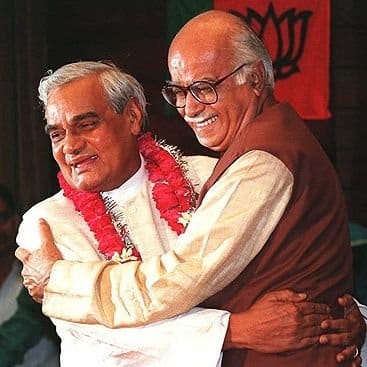
There are two persons who I am missing immensely today. The first one is late Shri Atal Bihari Vajpayee, who had been an integral part of my life- both political and personal, and with whom I shared an unbreakable and everlasting bond of mutual trust, affection and respect.
The second person is my late wife Kamla, who had been the mainstay of stability and a source of unparalleled strength to me, not only during the Shri Ram Rath Yatra, but throughout my long stint in public life.
In the run-up to the upcoming special occasion of 22nd January 2024, the atmosphere in the entire country has truly become ‘Ram-maya’. This is a moment of fulfilment for me, not just as a proud member of the RSS and the BJP, but as a proud citizen of our glorious motherland. My greetings to all my countrymen!
When Prime Minister Shri Narendra Modi does the ‘Pran Pratishtha’ of Shri Ram Lalla’s idol at Ayodhya, he would be representing every citizen of our great Bharat. It is my belief and my hope that this temple will inspire all Indians to imbibe Shri Ram’s virtues. I also pray that our great country not only continues to accelerate on the path of becoming a global power, but also presents itself as a sterling example of dignity and decorum in all walks of life.
I bow at the lotus feet of Shri Ram. May He keep everyone blessed. JAI SHRI RAM!
Watch a documentary on LK Advani’s “Fulfillment of a Divine Dream”
Yeh Mele Kabhi Kam Na Honge – Afsos Hum Na Honge
By Sunil Sarpal
This sums up how this creation is evolved and running. People come, zoom and go one day but the creation exists and function as it is.
Some times the economy of USA will overwhelm, sometimes it is China prosperous and and sometimes it is Russia. But Indian style of functioning is altogether a different kind of recipe. India does not attack first, notwithstanding China’s aggressive and intimidating ploys and even not like Russian invasion of Ukrain. But other nations do not take a leaf from Indian line of thinking and keep on beating their own trumpet the way they like.
Although Pakistan is badly under debt but does not spare India from terrorist activities.
Most of the nations aspire a foothold on the moon but not bothered about two nations fighting for issues which could be resolved thru dialogue or compromise formulae. It takes years and decades to build a nation but an atom’s explosion can turn a nation into debris, just like Hiroshima or Nagasaki.
Every nation wants to enrich itself with still more arms and ammunitions but cannot extend a helping hand towards a starving nation such as Pakistan.
A speeding car often found whistle past a hungry beggar but there is no compassion or empathy on the part of the car owner to provide some food for the beggar.
This is the pathetic drama being enacted among human beings but nobody gives any heed to the harsh reality of life that all the human beings are here because of God but some struggle to cope up with two times meal for their survival.
Living in posh bungalow, eating non-veg and drinking liquor or wine is what a man aspires for. Man knows that his stay here is numbered in years and one day he has to depart from this mortal frame. People give a damn to this hard fact of life and keep on accumulating more and still more.
Satguru says ‘ Calling Ram Naam behind the last journey of a dead body does not entitle him to merge back in Ram. One has to ensure that Ram Naam needs to be made an integral part of one’s life by doing daily bhajan simran and there is no other way out.
People remain in the rat race of buying a latest modelled car or constructing a house in the hilly area, so on and so forth. What about the creator because of whom we are here. It is the creator, the God, who will take care of our soul back to its true home.
What is the harm living in the will of God and doing daily bhajan simran. Why to keep running after more and still more pennies day-in and day-out.
YEH MELE KABHI KAM NA HONGE AFSOS HUM NA HONGE
Social Ethics, Etiquettes, Do’s and Don’ts
By Sunil Sarpal
Àre we talking about etiquettes like what to wear, when and how to set the table? Eg. with cutlery, forks always go on the left. Knives on the right. Glassware is set above the knives. In dressing, put on high-end pieces such as blazers, jumpsuits, and quality shoes to look more elegant, mature, and refined. Adopt a smart, casual look to dress fashionably and stylishly? Answer is a big NO.
Actually, the following 21 etiquettes are based on ethics and human values. You are welcome to expand the list
1. Don’t call someone more than twice continuously. If they don’t pick up your call, presume they have something important to attend to;
2. Return money that you have borrowed even before the person that borrowed from you remembers or asks for it. It shows your integrity and character. Same goes with umbrellas, pens and lunch boxes.
3. Never order the expensive dish on the menu when someone is treating you to a lunch/dinner.
4. Don’t ask awkward questions like ‘Oh so you aren’t married yet?’ Or ‘Don’t you have kids?’ or ‘Why didn’t you buy a house?’ Or ‘why don’t you buy a car?’ For God’s sake it isn’t your problem;
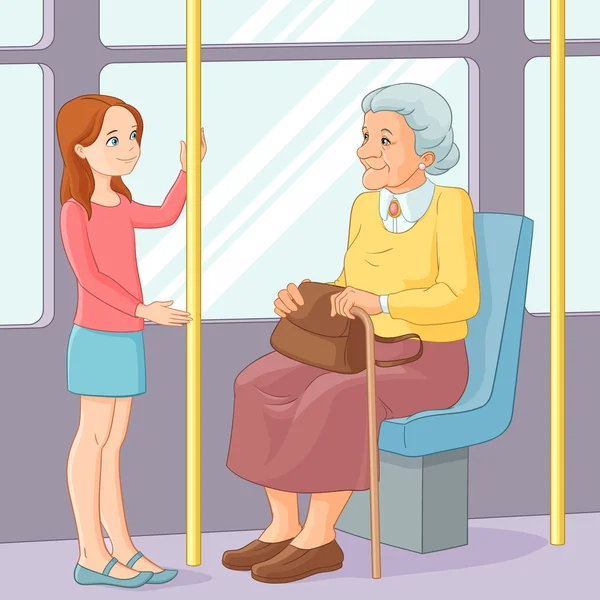
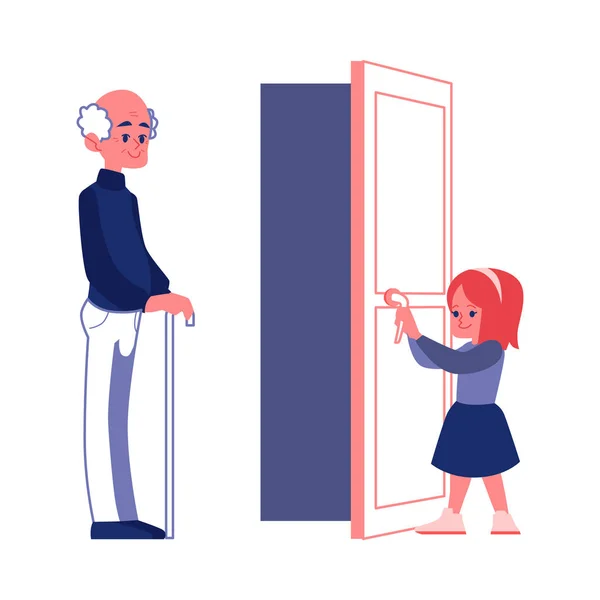
5. Always open the door for the person coming behind you. It doesn’t matter if it is a guy or a girl, senior or junior. You don’t grow small by treating someone well in public;
6. If you take a taxi with a friend and he/she pays now, try paying next time;
7. Respect different shades of opinions. Remember what’s 6 to you will appear 9 to someone facing you. Besides, second opinion is good for an alternative;
8. Never interrupt people talking. Allow them to pour it out. As they say, hear them all and filter them all;
9. If you tease someone, and they don’t seem to enjoy it, stop it and never do it again. It encourages one to do more and it shows how appreciative you’re;
10. Say “thank you” when someone is helping you.
11. Praise publicly. Criticize privately;
12. There’s almost never a reason to comment on someone’s weight. Just say, “You look fantastic.” If they want to talk about losing weight, they will;
13. When someone shows you a photo on their phone, don’t swipe left or right. You never know what’s next;
14. If a colleague tells you they have a doctors’ appointment, don’t ask what it’s for, just say “I hope you’re okay”. Don’t put them in the uncomfortable position of having to tell you their personal illness. If they want you to know, they’ll do so without your inquisitiveness;
15. Treat the cleaner with the same respect as the CEO. Nobody is impressed at how rude you can treat someone below you but people will notice if you treat them with respect;
16. If a person is speaking directly to you, staring at your phone is rude;
17. Never give advice until you’re asked;
18. When meeting someone after a long time, unless they want to talk about it, don’t ask them their age and salary;
19. Mind your business unless anything involves you directly – just stay out of it;
20. Remove your sunglasses if you are talking to anyone in the street. It is a sign of respect. Moreso, eye contact is as important as your speech; and
21. Never talk about your riches in the midst of the poor. Similarly, don’t talk about your children in the midst of the barren.
22. After reading you are welcome to suggest more points to ponder over in the comments box below the article on the website.
Can Pacifists like Modi and Macron help to nudge the world towards peace?
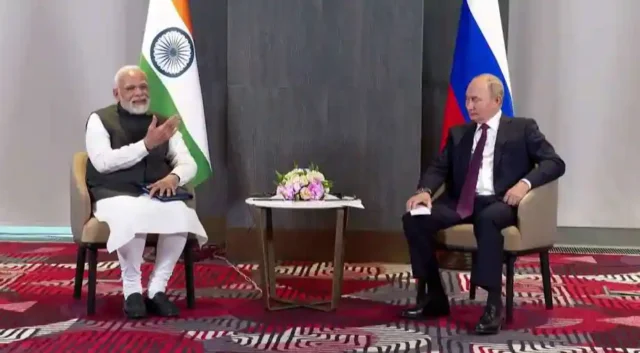
War helps no one on this planet – specially not the people, plants and all living beings who inhabit it. One Vorld One Universe One Mankind is the guiding principle, which will help resolve all issues. One would like to promote world peace, but with dignity for all and without compromise to extremism. There are hardly any who talk about peace in the present scenario in Europe. However two leaders who stand out and are proactive about peace are undoubtedly Modi and Macron. PM Modi’s role came into limelight during SCO summit, but ever since war began he has been talking about peace privately to Putin and also Zelensky. On the other hand President Macron met President Putin in Moscow, way back in February 2022 aiming for a de-escalation.
Prime Minister Narendra Modi’s advice to Russian President Vladimir Putin over the Ukraine war during a bilateral meeting on the sidelines of the Shanghai Cooperation Organization (SCO) summit at Samarkand in Uzbekistan has created hopes that perhaps it might be a catalyst to the end of Russia-Ukraine war. While his intervention has received approval from the world leaders, it has also grabbed the attention of leading international press and media
Japanese publication, NHK headlined “Indian PM Modi tells Putin to pursue peace”, Even Chinese media approved of it as the Hong Kong-based l South China Morning Post reported: Now is ‘not a time for war’, India’s Modi tells Russia’s Putin who agrees to ‘end this as soon as possible.’
Politico from US reported; “India’s Modi tells Putin: This is ‘not the era for war” and US News headlines was “Indian PM Modi Tells Russia’s Putin Now ‘Is Not an Era of War”.
On Internationally telecast media, while expressing his concerns about the impact of the war on food and energy security, PM Modi told Putin, “Today’s era is not of war and I have spoken to you about it on the call. Today we will get the opportunity to talk about how we can progress on the path of peace. India and Russia have stayed together with each other for several decades,”
“We spoke several times on the phone about India-Russia bilateral relations and various issues. We should find ways to address the problems of food, fuel security and fertilizers. I want to thank Russia and Ukraine for helping us to evacuate our students from Ukraine,” the Prime Minister added.
International media appreciated PM Modi’s diplomatic tact, who in a friendly manner pushed the concerns of the world at large to its long-standing friend Russia.
CNN appreciated PM Modi’s understanding of the situation and reported ” Indian leader Narendra Modi tells Putin: Now is not the time for war”
Washington Post, headlined “Modi rebukes Putin over war in Ukraine”.
“India’s Leader Tells Putin That Now Is Not an Era for War,” The New York Times said in its headline
Following the SCO summit, India’s role as a peace maker was applauded at the 77th UN General Assembly by world leaders. French President Emmanuel Macron proclaimed that Indian PM Modi was right when he said that time is not for war, not for revenge against the west or for opposing the west against east. It is time for our sovereign equal states to cope together with challenges we face: . German envoy quipped “very well put” to PM Modis remark on the Russia Ukraine conflict. US National Security Advisor Jake Sullivan cited Modi’s remark urging Putin to end the war. Other world leaders like Ukrainian President, Volodymyr Zelensky , Russian Foreign Minister Sergey Lavrov,also cited Modi’s advice in their speeches. Indian External Affairs Minister summarized; “I am concluding this week with the sense that India really matters more in this polarised world and much of that is also due to the Prime Minister’s leadership, his image, what he has done on the global stage,”
PM Modi also had a telephonic conversation with Ukrainian President Volodymyr Zelensky wherein as per official sources, he conveyed India’s readiness to contribute to any peace efforts in the Russia-Ukraine crisis. he stated that there can be no military solution to the conflict and reiterated his call for early cessation of hostilities and the need to pursue the path of dialogue and diplomacy..
Unlike India, France did not take a neutral stand at UN and voted against Russia in the security council. Yet even before PM Modi’s advice to President Putin Macron has been advocating a reconciliatory approach. As reported by world media, including EuroNews
As far back as May 2022, French President Emmanuel Macron has warned against humiliating Russia for its invasion of Ukraine, if and when any peace settlement is agreed.
He told reporters in Strasbourg that once the war ends, Moscow and Kyiv will eventually have to sit down and negotiate with each other, so any further tensions will only serve to the detriment of the situation.
“We will have a peace to build tomorrow, let us never forget that,” Macron said on Monday. “I mentioned this earlier. We will have to do this with Ukraine and Russia around the table. The end of the discussion and the negotiation will be set by Ukraine and Russia. But it will not be done in denial, nor in exclusion of each other, nor even in humiliation.”
Macron also laid out his vision of a broader community of European democracies that would allow for deeper cooperation between non-EU countries. (EuroNews 9th May)
Even earlier on February 7, 2022 NY Times headline news was “Macron meets Putin in Moscow, aiming for a de-escalation”. It went on to add “President Emmanuel Macron of France, who has positioned himself at the center of Europe’s furious diplomatic maneuvering over Ukraine, said on Monday that the continent was at a “critical crossroads” as he met in Moscow with President Vladimir V. Putin of Russia”..However there were murmurs of disapproval by some other countries watch the vido below to get both sided of the story.
Our Columnist Sunil Sarpal recalls the recent background to this war.
The war between USSR and Ukrain broke out approx. 6 months ago. The cause of disenchantment was that USSR did not want Ukrain joining NATO. USSR feared that if Ukrain, whose border separates the two nations, join NATO, other NATO affiliated nations’ forces could line up Ukrain border and intimidate USSR. As of now, the situation has unfolded that 20% Ukrain territory is under USSR control and the war goes on unabated. The devastation took place because of the war is unprecedented.
Is Zelenskey responsible for the war or Putin ?
Putin’s invasion of Ukrain proved a total miscalculation. As days progressed, it seems that the war will go on and on. Because Ukrain forces retaliated in such a manner that USSR forces ran away from the warring zone, leaving behind tanks, arma and others weapons in order to save their lives.
On both sides, the loss of lives and infrastructure took place as never before.
When war broke out an assurance came from none other than USA to Ukrain that they are whole-heartedly behind them, but USA never sent his forces to Ukrain. Of course, sanctions and war-related weapons etc have been supplied by them as well as by Germany. The fear factor on the part of USA could be that if their forces join hands with Ukrain, it would turn out to be a world war.
If Ukrain President Zelenskey is so very stubborn to prolong the war and asking for help from USA and other nations, then Ukrain inviting more trouble. The complete devastation of Ukrain could be averted if Zelenskey relents to Putin’s stand. On the face of USSR might, Ukrain’s defeat is on the cards whatever or how much coming their way.
In this war, both Putin and Zelenskey are held responsible because of their respective stands. Attempts have been made to kill both Putin and Zelenskey separately thru bombs but both escaped unscathed.
But will the momentum for peace, proposed by pacifists like Modi and Macron, gather pace or will temporary victories or setbacks of either side stall the move towards détente, remains to be seen – Manohar Khushalani.
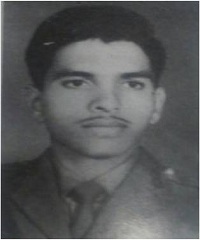
BRAVEHEART Capt Ashok Krishnarao Karkare, Vir Chakra
Penned down By his Elder Brother, Capt. Arun Karkare of Merchant Marine
IC21909 -35LT REGT, Vir Chakra CAPT ASHOK KRISHNARAO KARKARE
This brave heart was born on 30th June 1942 in Wardha, Maharashtra. Ashok was the third child blessed to the parents Krishnarao & Sumati Karkare. As the luck could have it, exactly a year later father Krishnarao joined the then Royal Indian Air Force (RIAF) in search of a better life for himself and the family. Ashok brought new job for his father and a better life for his siblings Sheela and Arun too. Things were on the move for all concerned. The family moved to Delhi as Flight lieutenant Karkare was posted at Air Head Quarters there.
Unfortunately, as child of 2 yrs age Ashok was struck by a rare bone disease then known as “RICKETS”. This bone- softening disease in children is due to failure of the body to maintain adequate level of calcium and phosphorus and this resulted in the hampering of the normal growth of baby Ashok to a point that it was evident that Ashok would not make it to a normal expected height as a youth. There was neither timely quality medical help nor remedy available to Ashok. As the days flew past, Ashok overcame this disadvantage. But the destiny had a different plan in place to use this physical adversity. Ashok excelled in field games such as football, hockey and relay race during his school days in Delhi and London and later in his college in Gurgoan.
Ashok attended School in London as his father was now posted as Assistant Air Attaché at the Indian Embassy in Paris –France. This experience was God sent as he blossomed into a smart young boy. On return to India at the age of 15yrs he continued his education but now a strong attraction to serve in any of the three armed services took charge of his mind. Men in uniform simply fascinated his tender mind with desire to join Army. But his father alerted him about his height disadvantage as it was below the Army standards! Ashok was sad and disappointed indeed.
Now destiny unfolded its plan for him. In 1962 Indo-China war took place. Indian Army needed urgent recruitment of officers. It opened up Officer’s Training School (OTS) at Chennai to train emergency commissioned offices. Ashok applied for it. He was in 2nd year BA-degree course then. He kept it as a well guarded secret. No one got the wind of it at home! He cleared all the prerequisite tests except the final interview followed by medical fitness test. He had to disclose now about his application to join Army to his parents as he prepared to leave for the final rendezvous with his destiny so to say.
At the interview the miracle happened. A Major General heading the interview team said “Mr Ashok Karkare, Are you not aware of the height requirement for joining Army?”
Representative Image of Army Interview
Ashok was ready with his make or break answer and said
“ I am well aware of it but please note that being short I will be perhaps last one to die in bullet fire from enemy thus holding the ground till the end for my beloved nation !” His words stunned the entire interview board. They clapped and said “we need people like you. You are selected “.
Rest is history. Ashok fought like a lion in 1971 war and proved every word he said in the board room. He brought glory to his nation, family and to himself. JAI HIND.
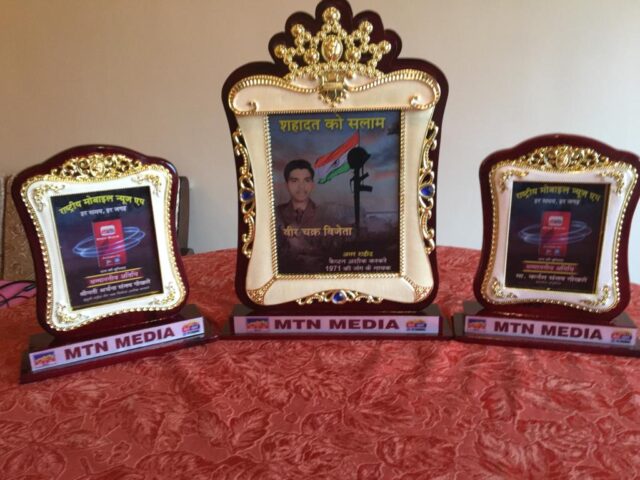
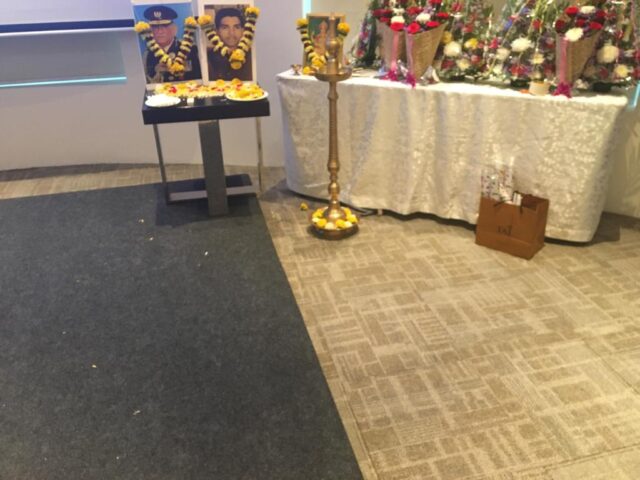
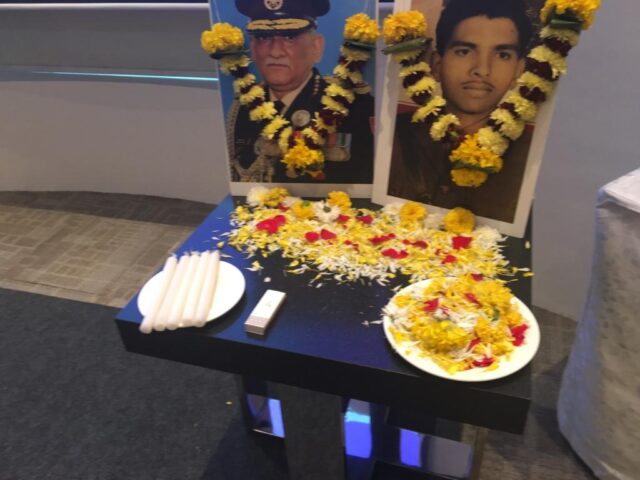
Metro city channel held a special function to honour Capt .Ashok Karkare, VirChakra winner, at Taj Santacruz hotel, Mumbai, with union minister Ramdas Athavle as chief guest. A documentary film has been made on Capt Ashok that was shown on the occassion. Special momentous were given to us too . Ashok and CDS Rawat were in the same frame on the Stage. God is kind indeed. Arun Karkare
International Mutual Funds – An Investment Option
IMF-The New Global Ball Game
International funds are equity funds that invest in stocks of companies listed outside of India. These funds help you invest in some of the biggest companies in the world. International Mutual Funds offer exposure to certain assets classes like foreign companies which otherwise may not be easily possible for investors through existing mutual fund schemes. Since the Indian market has a very low correlation with some of the overseas markets, having global exposure ensures healthy diversification and gives exposure to foreign currency as an asset class.
Why International Funds
Get exposure to global leaders like Facebook and Google
Good way to reduce portfolio risk as markets around the world rarely go down together
Suitable for goals which are at least 5 years away
INTERNATIONAL MUTUAL FUNDS CAN FOLLOW TWO WAYS TO INVEST
Purchase stocks directly & build portfolio – ICICI Prudential US Bluechip Equity Fund ( Create own portfolio )
Invest in an existing global fund – PGIM India Global Equities Opportunities Fund ( Invest in PGIM Jennison Global Equity Opportunities Fund )
CATEGERISATION OF INTERNATIONAL MUTUAL FUNDS
Thematic International Mutual Funds – Follow theme based investing approach and invest in foreign companies that belong to the concerned theme . Themes could be along the lines of Mining , Natural Resources or Real Estate for example DSP World Mining Fund invest in mining companies like Rio Tinto , BHP or BARRICK. In a similar manner Aditya Birla Sun Life Global Real Estate Fund invest in Real Estate Companies in foreign .
Region or Country Specific Funds – These funds invest specific in particular region or country specific stock market . The AIM is to generate returns through available opportunities in the target market. Example- Motilal Oswal S&P 500 Index Fund invest in companies that are part of S&P 500 index or Greater China Equity Off-shore Fund which invests primarily in a diversified portfolio of companies incorporated or which have their registered office located in, or derive the predominant part of their economic activity from, a country in the Greater China region.
Global Markets – This funds invest in global and do not restrict themselves to A specific region or A country. If you invest in these funds then you get diversified portfolio with stocks from across the world. Example- ICICI Prudential Global Stable Equity Fund (FOF) or Sundaram Global Brand Fund
BENEFITS OF INTERNATIONAL MUTUAL FUNDS
Diversification – When investors buy stocks for an international portfolio, they are also effectively buying the currencies in which the stocks are quoted.
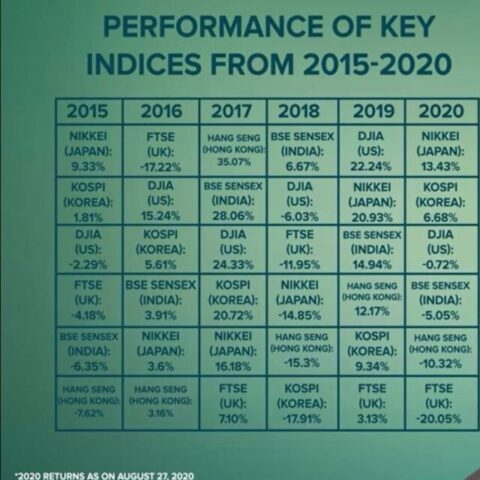
Economies of different countries simultaneously go through different growth cycles which maybe unrelated but studies have indicated that correlation reduces in the long term. Thus when you invest in other economies through mutual funds you can manage risks better and support overall gains even if your primary market underperforms. This balance ensures your portfolio volatility is maintained at the right levels your overall returns are not impacted drastically when the Indian economy may not be doing so well but others could be. There have been periods when Indian Benchmark indices have significantly underperformed global indices like S&P 500.
Become owner of Big Global Businesses- Example – Apple , Facebook , Google , Nike , Adidas , Coca Cola , Mc Donalds, Visa , P&G etc
Currency Diversification- The Indian rupee has been depreciating over the last few years, there are various reasons for this depreciation—from political instability to rising inflation levels to weak fiscal policies. One can take advantage of this situation by investing in international funds. When an investment is made in international funds, investors get exposure in foreign currency through investing in rupees. Any appreciation in the value of the foreign currency or any depreciation in the home currency will increase the returns.
In year 2000 $ 1 = INR 45 which in 2020 was $1= INR 75
RISKS OF INTERNATIONAL MUTUAL FUNDS
Economic & Political Risk: As international funds invest in other countries or regions, the change in the economic or political condition of the country can impact the performance of the country and, subsequently, this can affect the fund’s performance.
Currency Risk : Exchange rate movements could either enhance or diminish the return of that security. Currency risk, or exchange rate risk, comes from the chance that exchange rate movements could negatively impact an investment’s total return.
KEY TAKEAWAYS
An investment horizon of over 5 years or more is ideal in international mutual funds as it will flatten the risk of short term geopolitical events. It will also be beneficial from the perspective of taxation as these funds are taxed like debt funds and you can reap the benefit of indexation through long term capital gains tax.
‘Recovery’ in mental health a human rights issue
It may be a common sense assumption that when someone enters the world of treatment for their emotional or mental health issues their intention is to be relieved of their suffering, emerge healed and whole from the treatment. But does it really happen? Is there any way to know how many people actually exit the (mental health) system? Is anything going on in the treatment process that can actually lead to someone’s recovery?
By and large experiences of vast numbers of people are that once they enter into the system they are told by psy-professionals (and other medical professionals) of all hues that they would now have to rely on psychiatric medication for the rest of their lives. This insistence on medication, which is borne out of the agreed upon knowledge which all psy-professions draw from, invalidates the day-to-day suffering of people into a predetermined ‘illness’ category, complete with a diagnosis and prognosis. In 2019, I wrote this article which can be downloaded or read here or here which problematizes this aspect of treatment and questions what the goals of such treatment are.
It may be common sense assumption that when someone enters the world of treatment for their emotional or mental health issues their intention is to be relieved of their suffering, and emerge healed and whole. But does it really happen? Is there any way to know how many people actually exit the (mental health) system? Is there anything going on in the treatment process that can actually lead to someone’s recovery?
Research suggests that recovery is mostly not a goal psy-professionals target when they start treating people for their mental health issues. For most people the starting of treatment itself is ‘recovery’ because according to professionals the fact that people’s suffering has been recognized is itself a great victory over their ignorance: of being a mere suffering, while it is actually a real ‘illness’. However the truth from a ‘patient’s’ perspective is that until people take pharmacological treatments they believe themselves to be ‘ill’ or ‘sick’ and therefore not quite recovered. From the ‘patients’ ‘ position it is the ending of the treatment process and exiting psychiatry that counts as real recovery, not interminable treatments. Whether or not mental illness is a real illness is itself a topic of big discussion and debate, which I postpone for another location as of now.
Knowledge about recovery missing
When there is a gap in the social knowledge about a situation it has consequences; both for individuals, families and society as a whole. For example until penicillin was discovered by Alexander Flemming, a number of people would die for reasons as simple as flu or pneumonia. Antibiotics gave a new lease of life to people around the world and heralded a new era which cumulatively brought newer efforts that prolonged human life expectancy.
In the context of mental health when people are not aware that they can recover and they choose instead of continue taking medication, their lack of information is a knowledge or information gap. Instead of recovery their bodies become sites for testing newer drugs, yet no advancement produces the desired ‘cure’. When drug treatments continue for decades people not only become chronic patients, they also slowly develop co-morbid conditions such as thyroid malfunctions, liver damage, akathisia (I have written about it here), seizures, lupus and scores of other conditions, not to mention the ‘regular’ issues of hypertension, diabetes etc.
A lack of information about the possibility of recovery, which leads to never ending treatments is the issue addressed here. This knowledge or the lack of it, also called epistemic ignorance in research, becomes an issue of justice first of all. When people have unequal access to information in society, even though we live in the information age: the internet having created unprecedented possibilities for diffusion of ideas, only the idea of rising incidence of mental health issues are widely publicized, especially by the media and myriad psy-professionals. Treatments that do not end and progressively disable people, making them socially outcast and confined to their domestic spheres become an issue of justice- for what then are these treatments intended for?
Why human rights issue
When a patient or their caregiver is told by a psy-professional that their treatment is for life more often than not they do not question it, but accept the ‘diagnosis’ as a truth or fact. Treating people and the inability to produce a healing or cure, or letting them exit psychiatry by supporting drug withdrawal is not common or heard of. Long periods of remaining on these drugs makes people more and more disabled and socially marooned for they lose the confidence to deal with life, situations and other people.
The information of recovery is a right to knowledge about the idea of recovery. It is a right of every person who is on drug treatments to know how long their treatments would be and what alternatives exist. Until people do not realize that their interests and rights are being compromised if they continue taking drugs passively it will not help them, while pharma corporations will keep making steady incomes and rising profits. This is a gap of knowledge which can only be filled by people who have taken the path of recovery or who understand the injustice of denying people the knowledge about their mind and body. In one of my future pieces I will write about how the new Mental Healthcare Act of 2017 also does NOT support recovery and ensures people remain ‘patients’ ad infinitum, once they enter into the mental health system (that being the work I did for my doctorate)
Thank you for reading. If there is something more you would like to know about recovery from mental health challenges, or have a personal concern, you are welcome to post a query or comment in the comment box below. Prateeksha would be happy to respond to it, if necessary, even with a new blog post.