
India plants 66 million trees in 12 hours as part of record-breaking environmental campaign | The Independent

Volunteers in India planted more than 66 million trees in just 12 hours in a record-breaking environmental drive.

About 1.5 million people were involved in the huge plantation campaign, in which saplings were placed along the Narmada river in the state of Madhya Pradesh throughout Sunday. India committed under the Paris Agreement to increasing its forests by five million hectares before 2030 to combat climate change.

Read on…

https://www.independent.co.uk/news/world/asia/india-plant-66-million-trees-12-hours-environment-campaign-madhya-pradesh-global-warming-climate-a7820416.html


The Smarter City / Manu Bhatnagar

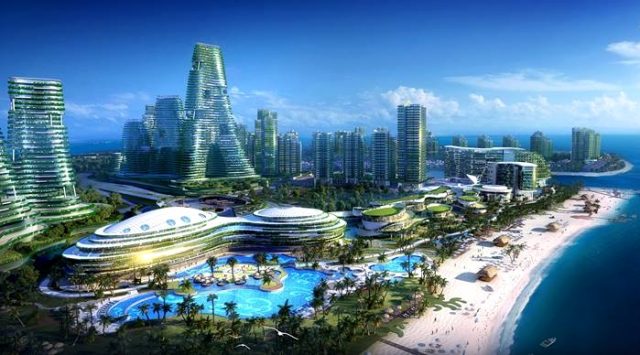
The question regarding Indian cities is whether they will metamorphose into a butterflies or ugly moths !

India is urbanizing, not at a trot or a canter, but at a gallop. Urban populations are beginning to overtake rural populations in some states. In 1991 the number of urban settlements were 3768 whereas in 2001 the numbers had gone up to 4378 and which have almost doubled to 7935 in the 2011 census. The dizzying urban explosion has overwhelmed natural resources and financial resources as well as the receding countryside.

Weak urban departments are at their wits end to come up with planning solutions. Feeble enforcement agencies are unable to prevent the distortion of elaborate masterplans at the ground level and administrations are forever having to regularize the irregular.

Cities are increasing vulnerable to climate change, dogged by pollution issues, subject to urban flooding, facing water insecurity, overwhelmed by housing and transport challenges, challenged by harsh environments and psychological aberrations.

The Sustainable Development Goals were adopted by the UN in September, 2017 and Goal no. 11 is about making cities inclusive, safe, resilient and sustainable. While disjointed attempts are being made to address some of the aforementioned challenges, resilience and sustainability are falling through the cracks between single issue focused agencies and between several layers of authority with divided sectoral jurisdictions. The reliance on capital intensive engineering solutions is compounded by a reluctance to adopt nature based simpler economical solutions, building nature into the urban fabric, forest bathing

What nature based solutions can a city adopt to become more resilient and sustainable ? Can we build nature into the urban fabric? Let us look at a few possibilities.

  1. Urban Forests : Presently our cities are bereft of forests. If lucky the city may have large parks but these do not provide the benefits of forests.
  • Forests moderate climate, provide a cooling effect, counter heat islands, can attract precipitation, help ground water recharge
  • It is well known that immersing oneself in forests has a healing effect on both psyche and physique. The Japanese have promoted the concept of ‘shinrinyoku’ or forest bathing to describe the practice of ‘getting into the woods for body and mind renewal to counter lifestyle related issues’.

Forests must be seen as a part of water, health and pollution control infrastructure. Therefore, greenfield developments must provide space for urban forests in the landuse plan. On the other hand already built settlements can consider building green buffers along large storm water nullahs, developing riverine forests, partially converting large parks into woodlands, creating woodlands in large campuses, terrace and vertical gardens.

  1. Water : Presently, cities are surviving by depleting rivers and aquifers. As the water crisis intensifies it can no longer be business as usual. Efficiency in the use of water [i.e. performing a task with less water than before], recycling [treating used water and utilizing it for an appropriate purpose again and again] to reduce the freshwater footprint, creating local water sources, is the way forward.

Several tasks can be performed with increasing efficiency. Thus, integrating dry toilets [at least in new developments] can eliminate flushing water, a particularly bad use of freshwater. Similarly, the use of herbal soaps [such as reetha powder] can curtail washing machine water use by half whereas the use of spray guns/bottles can greatly reduce water utilized for car washing.

Preserving waterbodies in and around urban areas can be done with recycled water from STPs. Usually, there is a stigma attached with the use of recycled water which prevents its popularity. Also, the ideas regarding dual piping systems in households [owing to costs and breakages/repairs] as also reuse in public gardens [required for only some days over 6 months] are impractical. But once the treated water is recharged to the aquifer through the bed of a waterbody the water recovered through tubewells is no longer stigmatized and is useful for all purposes in a decentralized way.

Just like the landuse plan must reserve space for forests so too the plan must provide space for waterbodies siting them in low lying areas as indicated by the topography. Likewise, large campuses may develop waterbodies in consonance with the drainage plan to gather their rainfall runoff as well as use the same to store wastewater treated in on campus decentralized treatment plants.

  • The elaboration of such practices on a large scale would make a significant contribution to the resilience and sustainability of our cities while reducing their water footprint.


Will Government Consider Forest Aquifers to Supply Drinking Water to Cities?

Water experts have said that the two principal unpolluted and perennial sources of water are the water in the ground below forests and the aquifers beneath rivers’ floodplains

read on…

https://thewire.in/environment/will-government-consider-forest-aquifers-to-supply-drinking-water-to-cities


‘Rampant Felling Of Trees Affects Right To Clean Air’, Says PIL

Karnataka HC Issues Notice To Tree Authority

Read on…..

https://www.livelaw.in/news-updates/rampant-felling-of-trees-affects-right-to-clean-air–145883


Groundwater overexploited in 16% of talukas, mandals, blocks, at ‘critical’ levels in 4% of wells examined – Firstpost

Groundwater level in 16 percent of the taluka, mandal, block level units in the country fall under the “over-exploited” category, while 4 percent falls under the “critical” category, government data show.

Groundwater level of the 6,584 block, mandal, tehsil level units assessed by the Central Groundwater Board reveal that 4,520 units fall under the “safe category”, according to the data shared by the government in Lok Sabha last week.

As many as 1,034 units have been categorised as “over-exploited”, the data state

Read on…

https://www.firstpost.com/india/groundwater-overexploited-in-16-of-talukas-mandals-blocks-at-critical-levels-in-4-of-wells-examined-6915801.html


Ancient Peruvian Water-Harvesting System Could Lessen Modern Water Shortages | VOA

Sometimes, modern problems require ancient solutions.

A 1,400-year-old Peruvian water-diverting method could supply up to 40,000 Olympic-size swimming pools’ worth of water to present-day Lima each year, according to new research published in Nature Sustainability.

It’s one example of how indigenous methods could supplement existing modern infrastructure in water-scarce countries worldwide.

Read on….

https://www.voanews.com/science-health/ancient-peruvian-water-harvesting-system-could-lessen-modern-water-shortages


5 Most Water Intensive Crops – Claro Energy

In the scope of Indian agriculture, a variety of crops is cultivated in India due to the vastly distinct weather and soil conditions that are available in various topographies across the country. These crops are majorly divided into food grains, cash crops, plantation crops and horticulture crops. Water is one of the essential resources that are required for proper growth of these crops. The majority of the farmers are still dependant on growing water intensive crops. Irrigation water, exclusive of precipitation and stored moisture, is required to meet the consumption rate of a crop during its growth period. But the amount of irrigation water required differs for each plant, not only because different plants need to survive different environments, but also because each plant has its own unique physical features.The rural Indian population is largely dependent on agriculture as its primary source of livelihood. Agriculture is one of the major contributors to India’s GDP, with an 18% share (KPMG report), this population plays an integral role in the Indian Economy.

In this regard, we would like to highlight some of the most water intensive crops that are popularly grown by Indian farmers.

Read on…

https://claroenergy.in/5-most-water-intensive-crops/


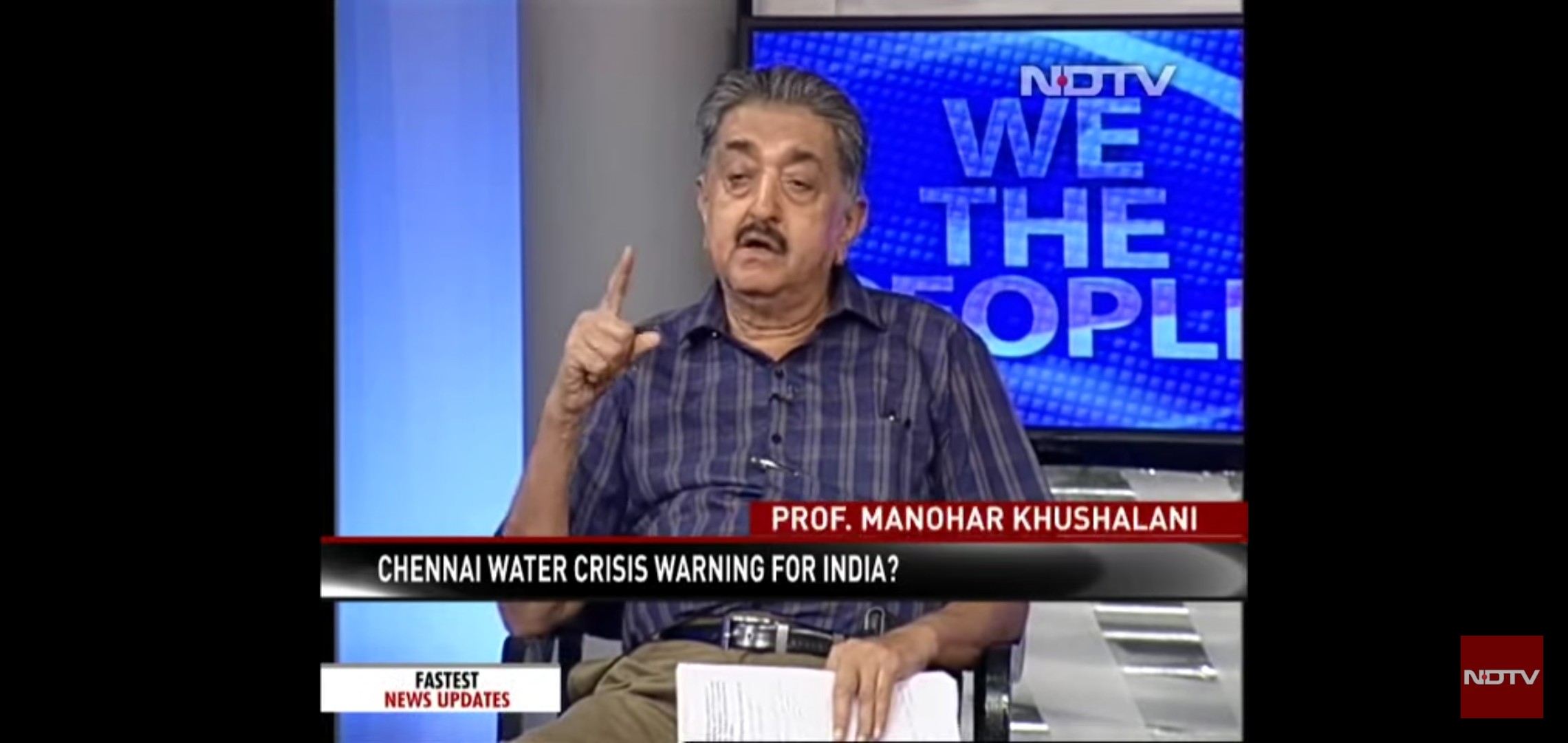
A TV panel discussion on the Water Crisis facing India with Manohar Khushalani, Raghav Chadha and Madhavan

Prof. Manohar Khushalani appeared live in a program anchored by the charming Gargi Rawat, on the NDTV series, WE THE PEOPLE. with Co-panelists Raghav Chadha and VK Madhavan. There were also Videocons with Medha Patkar an Other from Chennai.

On We The People we talked about an an issue that concerns everyone – India’s impending water emergency. The crisis is all around us. Chennai is facing the worst water crisis it has ever seen. With lakhs of people depending on private water tankers as taps go dry, establishments have had to be shut down, children are skipping school and lining up for water. And while Chennai is the largest city facing a water crisis right now, there’s a drought like situation in almost half the country. Parts of Maharashtra, Madhya Pradesh, Karnataka and Andhra Pradesh too are reeling under the crisis. On this show, panelists talked about steps we can take to prevent an impending water emergency.

If you are really worried about the Water Crisis in India don’t miss this program. Click on the link below. It was telecast at 6pm Saturday, 29th June, 2019


Yet Another Dead Whale Is Grave Reminder Of Our Massive Plastic Problem

A sperm whale was found washed ashore dead after swallowing 64 pounds of plastic debris. The male sperm whale was found on the Murcian coast in southern Spain in late February, reminding us how critical plastic waste in the oceans has become.

Read more:

https://www.forbes.com/sites/trevornace/2018/04/09/yet-another-dead-whale-is-grave-reminder-of-our-massive-plastic-problem/


Two apartment complexes in Bellandur are setting an example in harvesting the rain – Bangalore Mirror

By Reya Mehrotra

With no Cauvery water connection and borewells running dry, Green Glen Layout in Bellandur has got its forces together to catch every drop of rain. Various apartment complexes in the layout have taken up rainwater harvesting and each is doing it their own way. With each heavy rain, apartments in Green Glen Layout save more than 3,000-4,000 litres of rainwater and have installing meters to curb water usage.

Read the full article here

https://bangaloremirror.indiatimes.com/bangalore/others/two-apartment-complexes-in-bellandur-are-setting-an-example-in-harvesting-the-rain/articleshow/70014902.cms